Key Takeaways
- Track AI visibility by monitoring brand mentions across ChatGPT, Gemini, Claude, Perplexity, and Grok using a dedicated tool like Rank Prompt.
- Your AI visibility score is the percentage of relevant prompts where your brand appears, and it is your most important benchmark for improvement.
- Moving from a mention to a cited link requires structured content, schema markup, and ongoing competitor gap analysis.
If your company is not showing up in AI-generated answers, you are already behind. The shift is not coming; it is here. Over half of U.S. adults now use generative AI regularly, and the number keeps growing month over month. The question is no longer whether AI answers influence your customers. It is whether your brand appears in those answers.
Knowing how to track AI visibility gives you something most businesses still do not have: a clear, measurable picture of where your brand stands across every major AI platform. You can see when you are mentioned, when you are cited with a link, and when a competitor takes the spot that should be yours.
This guide breaks down the full process, including what to measure, which platforms matter, how to use Rank Prompt for monitoring, and how to turn your data into a content action plan.
Why AI Visibility Now Matters More Than Rankings
Traditional SEO ranking reports tell you where your pages appear in Google search results. That still matters, but it no longer tells the full story. A growing share of your potential customers are typing questions directly into ChatGPT, asking Perplexity for vendor recommendations, and trusting those answers without ever clicking through to a list of links.
The problem for most businesses is that they have no idea whether they appear in those answers or not. Your web development and web design work might be excellent, your pricing fair, and your portfolio strong. But if AI systems cannot retrieve and trust information about your brand, they will confidently recommend someone else.
According to research highlighted by Rank Prompt, about half of consumers now choose AI-powered search, and Google AI Overviews alone can reduce clicks to top organic results by roughly one third. That is a significant traffic impact for brands that are not thinking about AI visibility alongside their traditional SEO strategy.
The good news is this is measurable. You do not have to guess. You can run specific prompts, track where your brand appears, calculate a score, and use that data to make targeted improvements.
What Is an AI Visibility Score?
Your AI visibility score is the percentage of relevant AI queries where your brand name appears in the response. It is a share-of-voice metric built specifically for answer engines rather than search results pages.
Here is a simple example. If you run 60 prompts related to your services and your brand shows up in 18 of the responses, your AI visibility score is 30%. That number becomes your baseline. You track it over time, compare it against competitors, and measure the impact of any content or technical changes you make.
This kind of benchmark matters especially for digital marketing agencies Philippines-based brands and other service providers, because AI answers are increasingly shaping buyer decisions before anyone visits a website. A low score is not necessarily a reflection of poor service quality. It usually signals that AI systems do not have enough clear, structured, trustworthy information about your brand to feel confident mentioning you.
Share of Voice vs. AI Visibility Score
These two metrics are related but distinct.
Your AI visibility score measures frequency: how often you appear. Your Share of Voice measures prominence: where you appear relative to your competitors. You can have a decent AI visibility score and still be consistently listed third or fourth, which means competitors are owning the top position in each response.
Tracking both numbers gives you a complete picture of your current position and where the leverage points are.
The Six AI Platforms You Need to Monitor
Not all AI platforms draw from the same sources or apply the same weighting. Your brand might perform well on one and be absent from another entirely. Effective monitoring covers all six of the major platforms where users are getting AI-generated answers:
- ChatGPT (OpenAI): the most widely used AI assistant globally
- Gemini (Google): increasingly integrated into Google Search and Workspace
- Claude (Anthropic): growing in enterprise and research use cases
- Perplexity: a popular choice for research-oriented users who value citations
- Grok (xAI): Twitter/X’s built-in AI assistant with a different data profile
- Google AI Overviews: the AI-generated summaries appearing above traditional search results
Each platform has a different data diet, a different citation preference, and a different audience profile. A monitoring tool that covers all six gives you a far more complete view of your brand’s total AI presence than one that focuses on only one or two platforms.
For comparison, tools reviewed by Rank Prompt for AI visibility emphasize that presence across ChatGPT, Gemini, Claude, Perplexity, and Google AI Overviews, combined with verifiable citations and strong entity alignment, is what builds durable AI visibility in 2026.
How to Use Rank Prompt to Track AI Visibility Step by Step
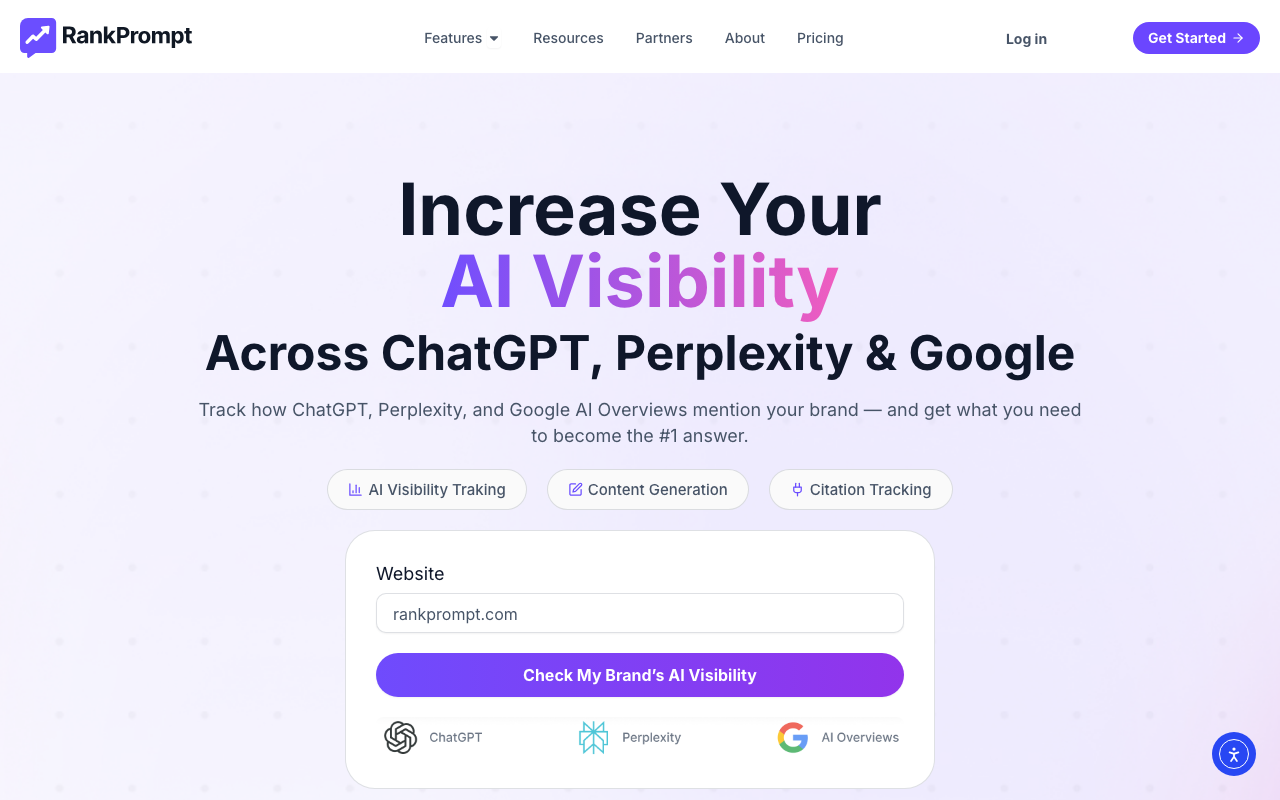
Rank Prompt is one of the most purpose-built tools available for tracking AI visibility at the brand level. Here is how to use it effectively from setup through analysis.
Step 1: Set Up Brand Monitoring
Start by connecting your brand inside the Rank Prompt dashboard. The platform will monitor your name, your key product or service lines, and any variations of how your brand might be referenced across all six major AI platforms. This is your foundation; the data you collect here feeds every other step.
You do not need to configure everything perfectly on day one. Start with your primary brand name and one or two service categories. You can expand your monitoring scope as you understand what prompts are actually driving results.
Step 2: Create Your Prompt Sets by Intent
This is the most strategic step in the entire process. Your prompt sets should mirror the actual questions your target customers are asking in conversational language. Group them into three categories:
- Intent queries: “What are the best [your service type] providers for [your target client]?”
- Comparison queries: “[Your brand] vs. [Competitor]” or “Who is better for [specific use case]?”
- Solution queries: “How do I [problem your brand solves]?” or “Which tool helps with [outcome]?”
Natural language works best here. Avoid keyword-tool phrasing. Write prompts the way a real person at a laptop would type them at 9am when they need a recommendation. This approach is the practical application of AEO (Answer Engine Optimization), which means structuring your content and monitoring around how AI systems surface brand information in direct responses.
A prompt set of 25 to 50 queries is a strong starting point. You can add more as patterns emerge from your data.
Step 3: Run Automated Reports on a Set Schedule
Manual prompt testing has its place for spot-checks and experiments, but it is not scalable for ongoing monitoring. Rank Prompt lets you schedule automated reports on a daily, weekly, or monthly basis so that changes in your visibility score are captured consistently without manual input.
For competitive categories like conversion rate optimization software or performance marketing tools, weekly reporting gives you the granularity to catch shifts quickly. For more stable service industries, monthly automated reports are usually sufficient.
The goal of automation is to build a long enough data set that trends become visible. A two-week snapshot is interesting. A six-month trend line is a strategic asset.
Step 4: Interpret Your AI Visibility Score
Once reports are running, your AI visibility score becomes your primary KPI. Do not treat it as a one-time diagnostic. Track it over time and look at it by platform, by prompt category, and against your competitors.
A high score on Perplexity but a low score on Gemini often points to a specific technical or content gap. Perplexity is heavily citation-driven and favors content with clear sourcing. Gemini is more integrated with Google’s knowledge graph and tends to favor brands with strong entity signals across the web. Knowing the difference helps you prioritize your improvements.

Reading Your Results: Mentions vs. Citations
Once your monitoring is active, every result you get will fall into one of two categories: a mention or a citation.
A mention is when the AI includes your brand name in its response without linking to your site. In Rank Prompt, these are flagged with a gray icon. Mentions build awareness and signal some level of brand recognition by the AI model, but they do not drive website traffic.
A citation is when the AI links directly to a specific page on your site as a source. These appear with a blue icon. Citations are the high-value result you are working toward, because they bring a user to your site with context already established. They showed up because they trusted the AI’s recommendation.
For a boutique agency focused on delivering quality over volume, this distinction is especially meaningful. One cited link from a well-matched AI answer can outperform dozens of generic organic visits, because the user already has intent and trust built in before they arrive.
How to Convert Mentions into Citations
The path from mention to citation runs through your content quality and structure. AI systems cite pages that are easy to retrieve, clearly organized, and backed by credibility signals. If you are being mentioned but not cited, these are the most common fixes:
- Restructure key pages to lead with a direct answer to the question, then support it with detail below
- Add FAQ schema, HowTo schema, and Article schema to your most important content
- Earn third-party mentions from credible industry sources, publications, and directories
- Build out author pages with genuine expertise signals, bylines, and linked credentials
Quality digital content creation is what makes this possible. Content that AI systems can retrieve, parse, and trust is the foundation of a strong citation rate.
Closing the Gap with Competitor Analysis and Content Studio
Knowing your own score is useful. Knowing which prompts your competitors are winning and you are not is where actionable strategy comes from.
Rank Prompt’s competitor gap analysis maps out the specific prompts where competing brands receive mentions or citations and your brand does not appear at all. That is essentially a prioritized content to-do list, delivered by data rather than guesswork.
If a competitor consistently appears when users ask about SEO services for local businesses or e-commerce brands, and your brand does not show up in those same prompts, that prompt cluster becomes your next content priority. Write content that answers those queries directly, structure it for AI consumption, and monitor whether your score in that category improves.
As Rank Prompt notes, AI systems answer questions using sources they can retrieve, understand, and summarize reliably. Competitor gap analysis tells you exactly which questions you have not yet given them an answer for.
Using Content Studio to Build the Right Content
Rank Prompt includes a Content Studio feature designed to help you create content specifically optimized for AI answer engines. It goes beyond traditional keyword targeting to help you structure content so that AI systems can actually pull it into responses.
This matters particularly for agencies doing serious web development and web design work for clients, because technically polished websites with poorly structured content still get skipped. Content Studio helps you bridge that gap by producing content that serves both human readers and AI retrieval systems at the same time.
Your AI Visibility Strategy Starts Now
Tracking AI visibility is not a passive, set-it-and-forget-it task. The brands consistently appearing in AI-generated answers are the ones running structured prompt sets, analyzing gap reports, publishing answer-first content, and repeating that cycle month after month.
The process is clear when you have the right tools. Set up monitoring across all six major platforms. Create prompt sets that reflect real customer language. Track your AI visibility score and Share of Voice over time. Use competitor gap data to direct your content investment. Refine with schema, citations, and author credibility.
Whether you are a large organization or a lean creative agency, the fundamentals do not change. Be findable. Be citable. Be accurate. The brands taking this seriously now are building a compounding advantage that will be genuinely difficult for slower movers to close.
Start tracking. The data will tell you exactly what to do next.
Want to Know Where Your Brand Stands in AI?
Studio Dakila helps businesses understand and improve their presence across AI platforms, from prompt strategy to content optimization. If you want a clear picture of your AI visibility score and a plan to improve it, we are ready to help.
Frequently Asked Questions
Start by using a monitoring tool like Rank Prompt to run 25 to 50 conversational prompts relevant to your industry and location. This gives you a baseline AI visibility score you can benchmark and improve against over time.
Traditional SEO measures your position in search engine results pages, while AI visibility tracks whether your brand appears in AI-generated answers on platforms like ChatGPT and Gemini. Both matter, but they require different content and technical strategies to improve.
Monthly monitoring is sufficient for most businesses, though competitive industries may benefit from weekly automated reports to catch shifts before they compound.
